Sorted, Not Skint: A Dealer Hall Field Guide for Canny Collectors
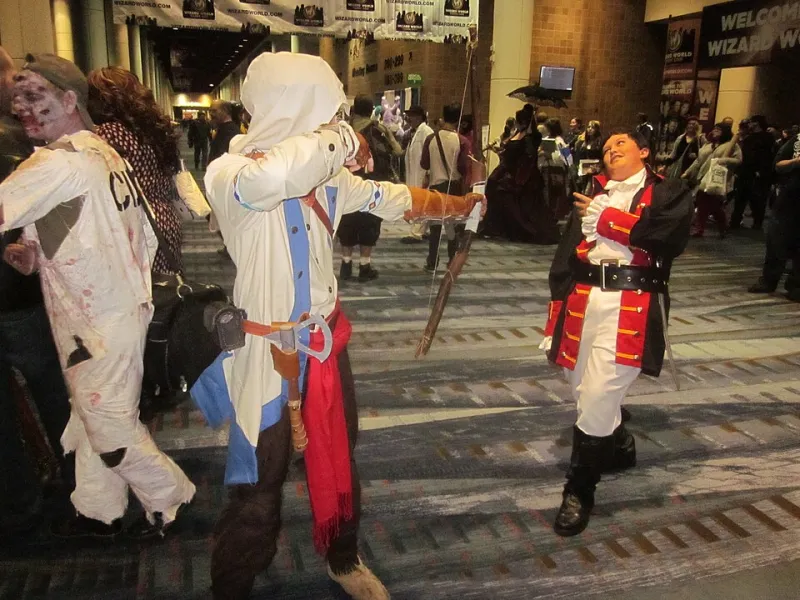
Photo: Infrogmation of New Orleans, CC BY-SA 3.0, via Wikimedia Commons
The dealer hall is designed to overwhelm you. That's not a criticism, it's just what happens when you put a hundred stalls, forty thousand comics and a wall of framed prints in one space and add a Sunday morning crowd. You walk in with a plan. Twelve minutes later you're holding a die-cast Delorean and you can't remember your own name.
So here's a field guide — the stuff I wish someone had told me before my first rummage. Bring a tote, bring cash, and read this on the Metro in.
Lap one: hands in pockets, wallet shut
Do a full circuit before you spend a penny. Not a slow circuit — a proper recce, aisle by aisle, noting who's selling what and roughly at what price. You'll see the same £15 box of back issues at four stalls and the same figure at three wildly different prices.
Use your phone to note the stall name or number for anything you're tempted by. You will not remember which aisle it was in. Nobody does.
Lap one ends with a shortlist. Lap two is where money changes hands. Anyone who buys on lap one is paying a tax for excitement, and it's usually about 30%.
Original or reprint? The quick checks
This is the big one, and it's not as technical as dealers make it sound.
- Check the indicia. That's the small print on the inside front page — publisher, volume, year, printing line. A 1974 book should say 1974 in there. If the indicia says 2021 and the stall says original, you've your answer.
- Look at the cover price. A silver-age comic with a modern cover price is a reprint, full stop. So is anything carrying 'not for resale' or a facsimile note — facsimiles are perfectly good products, they're just not original, and they shouldn't be priced like originals.
- Feel the paper. Older comics are newsprint: rougher, slightly yellowed, with a smell. Reprints are usually glossier and flatter.
- Look at the colour reproduction. Genuine old printing has slight misregistration and uneven colour. Reprints often look almost too clean, or over-saturated.
- Ask directly. 'Is this an original printing or a reprint?' A good dealer answers in one word and doesn't get defensive. A bad one changes the subject, and that tells you plenty.
None of this means reprints are bad. A £3 reprint of a book you'll never afford an original of is a cracking buy. Just don't pay original money for it.
Provenance: ask the boring question
For signed items, the story matters more than the certificate. Ask who signed it, when and where. A dealer who got it at a private signing will tell you the date and the event. A dealer who doesn't know is a dealer who bought a job lot.
A few rules of thumb:
- A COA proves very little on its own. Plenty are printed in-house. It's a nice extra, not an authentication.
- Witnessed signatures through the recognised grading schemes carry more weight, and they're priced accordingly. An unwitnessed signature can still be genuine and still be lovely to own — just don't pay witnessed money for it.
- Ask about restoration. For anything over about £50, 'has it been trimmed, pressed or colour-touched?' is a fair question and a reputable seller will answer without drama.
Grading, briefly — don't bluff it
The ten-point scale runs from 0.5 up to 10, with the useful landmarks being 9.4 (near mint), 8.0 (very fine), 6.0 (fine), 4.0 (very good) and 2.0 (good, which in comic language means 'bad').
You don't need to memorise it. You need five checks:
- Spine — ticks and colour-breaking creases.
- Corners — blunted or sharp.
- Staples — rust, tears, popped centre pages.
- Colour — fading, tanning, foxing on older newsprint.
- Water — rippling, tide marks, that faint musty smell.
Don't confidently announce a grade. Ask instead: 'How would you grade this, and what are you seeing that I should know about?' Dealers respect the question, and you learn a lot from the answer. A raw, ungraded book can be a proper bargain; a slabbed one is a known quantity priced to match. Neither is automatically the smart buy.
Haggling, the North East way
Haggling isn't arguing. It's a short, polite conversation with a clear ending.
- Bundle. Three books, one round number. 'Would you do twenty-five on these three?' works far better than chipping at one item.
- Ask once. 'Is there any movement on this?' One ask. If it's a no, it's a no.
- Never say you can get it cheaper online. You can. They know. You came to the hall to hold the thing, and being smug about eBay is a quick way to get a fixed smile.
- Don't haggle in a queue. If there's a line behind you, buy or move on.
- Timing is everything. Saturday morning is the worst moment to ask for a favour. Sunday afternoon, when a dealer is facing a van and three hundred boxes, is the best.
- Walk away nicely. 'Thanks, I'll have a think' is a complete sentence and it gets you out of any conversation with your dignity intact.
The envelope system that survives Sunday
Three envelopes, cash in each, labelled in biro like a sensible person:
- The one I came for. A specific book, figure or print. If you find it, great. If not, that money rolls over.
- The one I didn't know I wanted. Your rummage fund. Small notes, no regrets.
- Food, travel, and the pint afterwards. Non-negotiable. This one gets raided by nobody.
When an envelope's empty, it's empty. That's the entire system and it works better than any app. Bring a card for a genuine big-ticket item if you've set a limit in advance — but a lot of stalls are still cash-only, and the cash machines near the venue charge for the privilege, so draw your money out in town first.
The stall check list
Copy this into your notes before you leave the house:
- Torch or phone light for the deep boxes
- A tote, plus two rigid sleeves and boards for anything decent
- Notes app open for stall numbers and prices
- Cash in envelopes, small denominations
- The five checks: spine, corners, staples, colour, water
- One phrase ready: 'Thanks, I'll have a think'
And a bit of basic decency, which costs nothing: don't block a stall with your rucksack, ask before photographing stock, don't open sealed product without permission, and never rest a coffee on the table.
Sunday's leftovers
Here's the quiet secret. Sunday from about two o'clock, the hall thins out and dealers start thinking about packing. That's when a bundle price gets generous, when the £30 book becomes £20, and when you'll hear the words 'go on then, pet' from a stall that wouldn't have budged on Saturday.
It's also when you make your daftest purchase of the weekend. So check the envelope first, then the spine, then the indicia. In that order.
Happy hunting — and if you spot a decent copy of something you've been chasing for years, give the rest of us a shout. That's what the community's for.