Two Sentences and a Microphone: How to Ask a Panel Question That Actually Lands

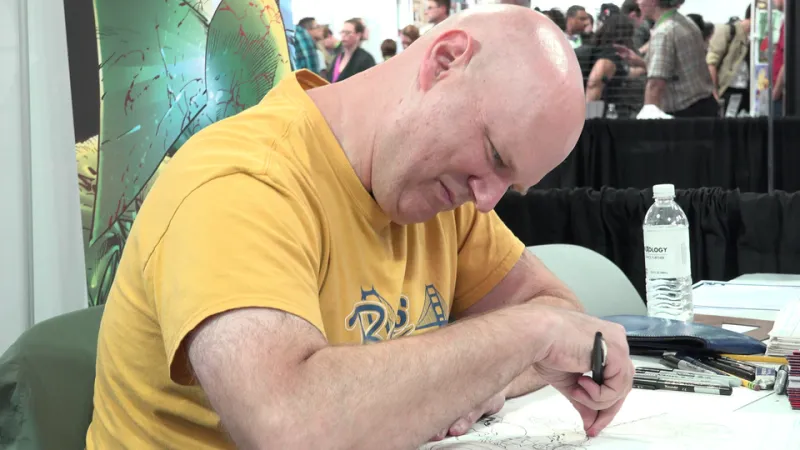
Photo: Gage Skidmore from Peoria, AZ, United States of America, CC BY-SA 2.0, via Wikimedia Commons
You've been in the panel room for thirty-five minutes. The guest has done the audition story, the wig story and the one about nearly being run over outside a hotel in Manchester. The runner is two rows away with a microphone, and your heart is doing something it doesn't normally do on a Sunday afternoon.
Then somebody behind you asks: 'What's your favourite colour?'
You can feel the room deflate. Not because it's a cruel question — it isn't — but because it costs the guest twelve seconds and gives them nothing to work with. They'll smile, say blue, probably, and hand the mic back. And the person after them might ask something that unlocks a twenty-minute story nobody in that hall has ever heard.
That gap is the whole game. Asking well at a convention panel isn't a talent you're born with. It's ten minutes of reading and a bit of restraint. Here's how I'd go about it.
The polite nod problem
Guests do hundreds of these. They arrive with a bank of answers: first day on set, hardest scene, what the fans mean to them. That's not laziness — it's efficiency, because there's ninety minutes on the clock and two hundred people in the room.
A generic question pulls a generic answer straight out of the bank. A specific question makes them actually remember something. And a remembered thing is what you'll be quoting on the Metro home.
Do the reading — ten minutes is genuinely enough
You don't need to have watched everything. You need one detail.
Pick a specific scene, a specific episode, a costume choice, a bit of casting news, an interview they gave to a podcast in 2023. Then build the question around that detail. Not 'what was it like filming?' but 'the corridor scene in episode four — I read it was shot in one take. What went wrong?'
That's the whole research phase. One detail. Done on the bus.
Same rule if the guest is a writer or an artist: ask about a specific page, a panel layout, a deadline, a decision they've spoken about. 'What did you cut that hurt?' will always beat 'where do you get your ideas?'
The two-sentence rule
Here's the line I'd print on the back of every lanyard: stand up, give your name, ask the question, sit down. Two sentences. Three if one of them is short.
Weak: 'Hi, so, this is a bit of a long one, and I've got sort of three things, but basically, right, I first saw you in — oh, what was it — that thing with the boat? And my mate Dave, hi Dave, he reckons...'
Better: 'Hi, I'm Sam from Gateshead. The stairwell scene — was it as cold as it looked?'
Length isn't just manners, either. Long questions let a guest lose the thread, and then you get a rambling answer to a question you didn't quite ask. Short questions are easier to answer brilliantly.
Read the room like a local
North East crowds are warm, but they're honest with it. There's a particular skill round here in being friendly without being over-familiar, and that's exactly the register a panel wants. Be yourself, be cheerful, but remember the guest is at work and there's a queue behind you.
Three things to swerve:
- The say-hi-to question. Tell a guest about the community if the moment allows, but the mic isn't a PA system and nobody in row nine is invested in your mate Dave.
- The personal question. Health, money, relationships, families. If it wouldn't be fair in a magazine interview, it isn't fair at a microphone.
- The correction. If a guest misremembers a scene, let them. You can be right in the pub afterwards, and you'll both be happier for it.
Same guest, two questions
Say the guest is an actor with a long-running sci-fi series behind them and a small indie film out this year.
-
Weak: 'What was it like working on the series?' — stock answer, every time.
-
Strong: 'You've said the indie film was shot in eighteen days. Did that change how you worked compared to the series?'
-
Weak: 'Any advice for aspiring actors?' — always answered, never usefully.
-
Strong: 'What's the one thing you'd tell your younger self about auditioning that nobody told you at the time?'
-
Weak: 'Do you like coming to Newcastle?' — the answer is yes, obviously.
-
Strong: 'You've been up here a few times now. Is there anything you've actually kept from the region — a habit, a food, a phrase?'
That last one has a bit of Geordie flavour without demanding a performance. There's a real difference between inviting somebody in and asking them to do the accent for the room.
The etiquette nobody writes down
- Sit near an aisle if you fancy your chances at the mic.
- Have a backup question. Your first one has probably already been asked. Mine always has.
- Check the filming policy on the signage before you start recording.
- Pass the mic back properly — don't make the runner reach across three people.
- One question per person when the room is busy. If it's quiet, you can have two. If it's busy, you've had your turn.
- If a guest says they can't talk about something, let it go. Their contract isn't a debate topic.
- Say thanks. Small thing. Gets remembered.
Why bother?
Because a convention is one of the few places where you can put a direct question to somebody whose work has genuinely mattered to you and get an answer in the same breath. That's a strange, generous thing, and it's worth turning up prepared for.
The 2026 panel schedule at Newcastle Film & Comic Con is going to be tight and the guest list is going to be big, which means the mic will be contested. The people who get remembered in that room aren't the loudest or the funniest. They're the ones who arrived with one good question, asked it in fifteen seconds, and walked away with a story.
Ten minutes of reading. Two sentences. One microphone. Go on then.